


By Tynan Heller, Director of Product: Software Engineering, Genasys Inc.
Key Takeaways:
- From guesswork to precision - AI simulation allows agencies to stress-test complex scenarios, replacing assumptions with data-driven planning that stands up under real-world pressure.
- See what happens before it does. Predictive modeling provides forward-looking insight during active incidents, helping leaders act earlier, allocate resources smarter, and stay ahead of rapidly changing conditions.
- Turn every incident into a strategic advantage with post-event simulation analysis that accelerates learning, revealing what worked, what did not, and how future outcomes can be improved with greater confidence.
Emergency management has long been defined by uncertainty, time pressure, and high-stakes decision-making. For decades, leaders have relied on experience, static plans, and fragmented data to guide response efforts. But a critical question is emerging across the industry: can AI simulation and modeling technology profoundly change the way emergencies are managed, or is it still more promise than practice?
The answer is becoming increasingly clear.
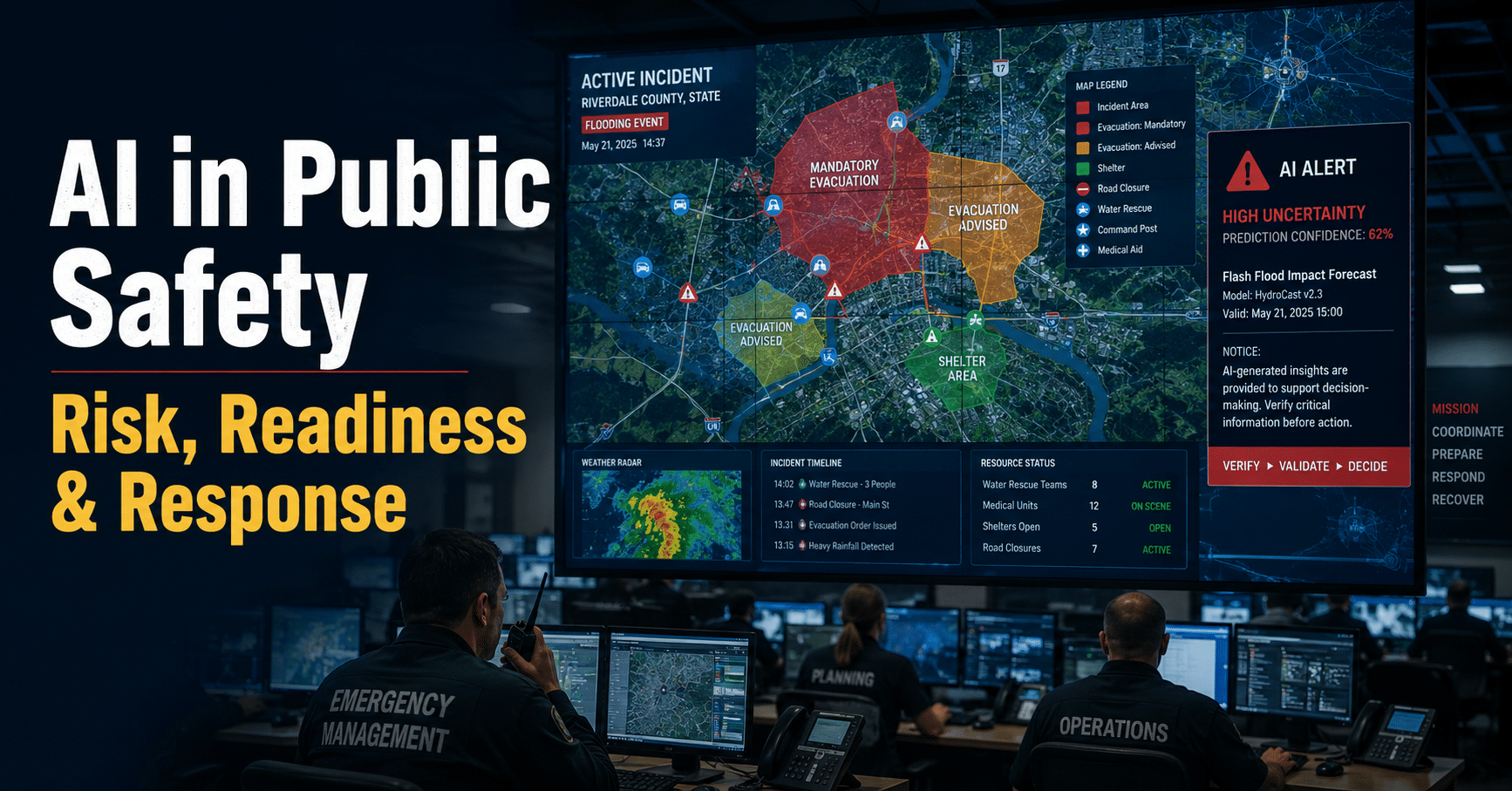
A fundamental shift is already underway. AI simulation is moving emergency management from reactive decision-making to predictive, scenario-driven strategy. Agencies are no longer limited to responding as events unfold. They can now anticipate how incidents may evolve, test multiple response strategies in advance, and make more informed decisions before conditions escalate.
Simulation and modeling represent a transformation in how agencies think, plan, and operate. One that prioritizes foresight, precision, and continuous improvement across every phase of an incident.
Turning "What If" Into Actionable Strategy
Traditional emergency planning often relies on static plans and historical data. While valuable, these approaches struggle to account for dynamic, real-world variables such as traffic congestion, infrastructure failure, or rapidly changing weather conditions.
Simulation and modeling technology changes this.
With AI simulation, agencies can run complex "what if" scenarios at scale:
- What happens if a wildfire forces simultaneous evacuations across multiple zones?
- How does heavy traffic impact evacuation timelines?
- What if a primary evacuation route becomes inaccessible?
- Would phased evacuations improve safety and reduce congestion?
These insights allow planners to move beyond assumptions and build adaptive, data-driven strategies. Instead of preparing for a single scenario, agencies can prepare for hundreds of possible outcomes.
The result is stronger preparedness, better resource allocation, and more defensible decision-making.
Anticipating What Happens Next
In the middle of an emergency, time is compressed and uncertainty is high. Decisions must be made quickly, often with incomplete information.
Simulation and modeling provide a forward-looking advantage.
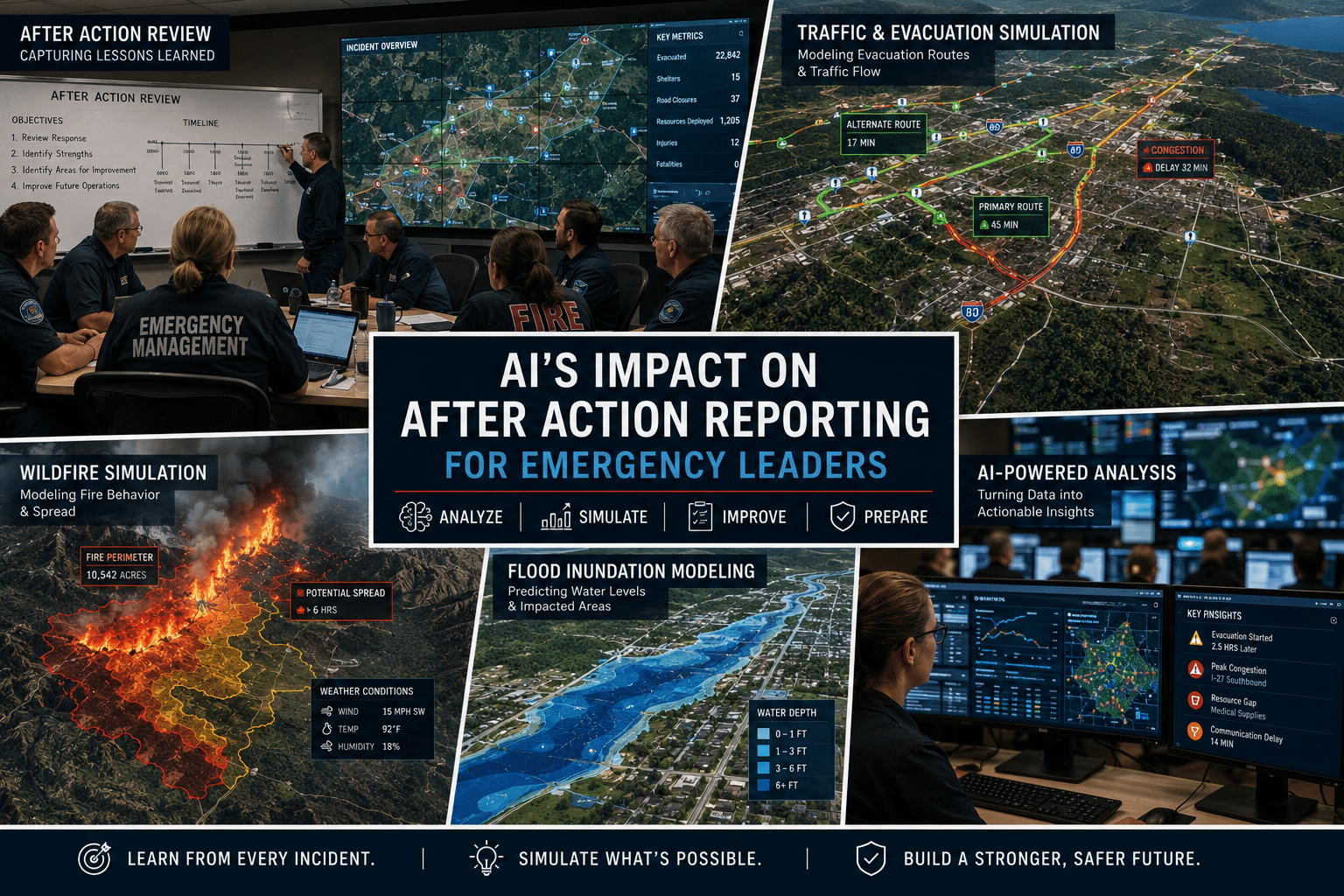
By incorporating real-time data and predictive analytics, AI simulation can forecast likely developments:
- Fire spread based on wind and terrain conditions
- Flood progression across vulnerable areas
- Traffic flow during active evacuations
This enables emergency managers to act ahead of the incident rather than behind it.
There is still some hesitation among responders when it comes to relying on simulations during active events. The responsibility for outcomes remains with human decision-makers, and trust in emerging technology takes time to build. However, as AI-optimized modeling technology continues to improve in accuracy and reliability, adoption is accelerating. Agencies are increasingly recognizing that simulation is about enhancing human judgment with better information.
After the Crisis - Learning Faster and Improving Continuously
Post-incident analysis has traditionally been time-intensive and limited by available data. Simulation and modeling transform this process into a deeper and more efficient exercise.
With AI simulation, agencies can:
- Reconstruct incidents with high accuracy
- Analyze decision points and outcomes
- Test alternative strategies after the fact
Leaders can ask critical questions:
- What if evacuations had started earlier
- What if resources had been deployed differently
- Would different routing strategies have reduced congestion
These insights allow organizations to move beyond surface-level reviews and into meaningful operational improvements.
Over time, this creates a cycle of continuous learning that strengthens future preparedness and response capabilities.
Where Simulation Meets Real-World Execution
The true value of simulation and modeling technology is realized when insights are translated into real-world action.
Modern platforms now integrate simulation outputs directly into operational workflows, enabling:
- Zone-based evacuation planning and execution
- Real-time public communication updates
- Coordinated multi-agency response
- A shared common operating picture
Solutions such as Genasys Protect bring these capabilities together by combining simulation-driven insights with communication tools that deliver clear, actionable information to both the public and response teams.
Genasys traffic and wildfire simulations, along with advanced flood modeling through FloodMapp, provide agencies with the ability to visualize risk, anticipate impact, and communicate with precision. This integration ensures that planning, response, and communication are aligned at every stage of an incident.
A New Standard for Emergency Management
Simulation and modeling technology are setting a new standard for emergency management.
Agencies that embrace AI simulation gain the ability to plan more effectively, respond more proactively, and learn more deeply from every event. As these tools continue to evolve, they will become essential components of modern public safety operations.
The future of emergency management is not just about responding to crises. It is about staying ahead of them.
To see how simulation, modeling, and real-time communications can strengthen your operations, contact Genasys for a demo and explore how your agency can move from reactive to predictive emergency management.
FAQs
What is AI simulation in emergency management?
AI simulation in emergency management uses data, algorithms, and modeling technology to predict how incidents may unfold. It helps agencies plan, respond, and analyze events more effectively.
How does simulation improve evacuation planning?
Simulation allows agencies to test different evacuation strategies, assess traffic impacts, and identify optimal routes. This leads to safer and more efficient evacuations.
Can AI simulation be trusted during real-time emergencies?
AI simulation is designed to support decision-making, not replace it. As accuracy improves, it is increasingly used to provide forward-looking insights that help responders act more confidently.
What role does modeling technology play after an incident?
Modeling technology enables detailed post-event analysis by recreating scenarios and testing alternative decisions. This helps agencies identify improvements and refine future strategies.