


By Evan Keats, Former Spokesman and Director of Community Affairs, Sarasota County Sheriff's Office
Key Takeaways:
- AI can improve situational awareness and decision-making in public safety, but poorly designed systems can create dangerous operational failures.
- Public safety agencies should prioritize trusted, transparent, and purpose-built AI tools over generic consumer AI platforms.
- Simulation, predictive modeling, and real-time intelligence platforms are emerging as some of the most valuable AI applications for emergency management.
Artificial intelligence is rapidly becoming part of the operational fabric of modern public safety. From predictive analytics and emergency modeling to information gathering and after action reporting, AI promises faster insights and more informed decision-making.
But there is a growing divide between AI that supports public safety operations and AI that introduces new operational risks.
For public safety professionals, the stakes are fundamentally different than they are in most industries. A wrong answer in retail may inconvenience a customer. A wrong answer during a wildfire evacuation, flood response, or active threat incident can cost lives.
The challenge is no longer whether agencies should use AI. The real question is which AI systems can be trusted in high consequence environments.
When AI Hallucinates, Public Safety Pays the Price
One of the biggest concerns surrounding the adoption of AI is reliability.
Large language models and generalized AI systems are known to occasionally "hallucinate," producing incorrect or fabricated information with high confidence. In public safety environments, that risk is unacceptable.
Recent headlines have highlighted AI systems generating false legal citations, inaccurate emergency summaries, and flawed operational recommendations. In one widely discussed case, AI-generated information contributed to confusion during critical decision-making workflows because responders trusted the output without verification.
Public safety agencies cannot afford blind trust in automation.
AI systems that operate without transparency, auditability, or human oversight can create cascading problems:
- Incorrect evacuation recommendations
- Misinterpreted incident intelligence
- Delayed response coordination
- Faulty situational awareness
- Public misinformation during emergencies
This is particularly dangerous during rapidly evolving incidents where decision windows are measured in minutes, not hours.
Generic AI Tools Were Not Built for Emergency Management
Many publicly available AI platforms were developed for broad consumer or enterprise productivity use cases. They were not designed for emergency operations centers, law enforcement coordination, or disaster response.
Public safety agencies require:
- Verified and defensible data sources
- Human-in-the-loop decision making
- Secure operational environments
- Real-time situational awareness
- Geospatial accuracy
- Clear audit trails
Without those safeguards, AI becomes an operational liability instead of an operational advantage.
This is why agencies are becoming increasingly selective about which AI systems they adopt. The future of AI in public safety will likely belong to specialized platforms built specifically for emergency communications, intelligence analysis, simulation, and operational coordination.
The Most Valuable AI May Be the AI That Helps Agencies Prepare
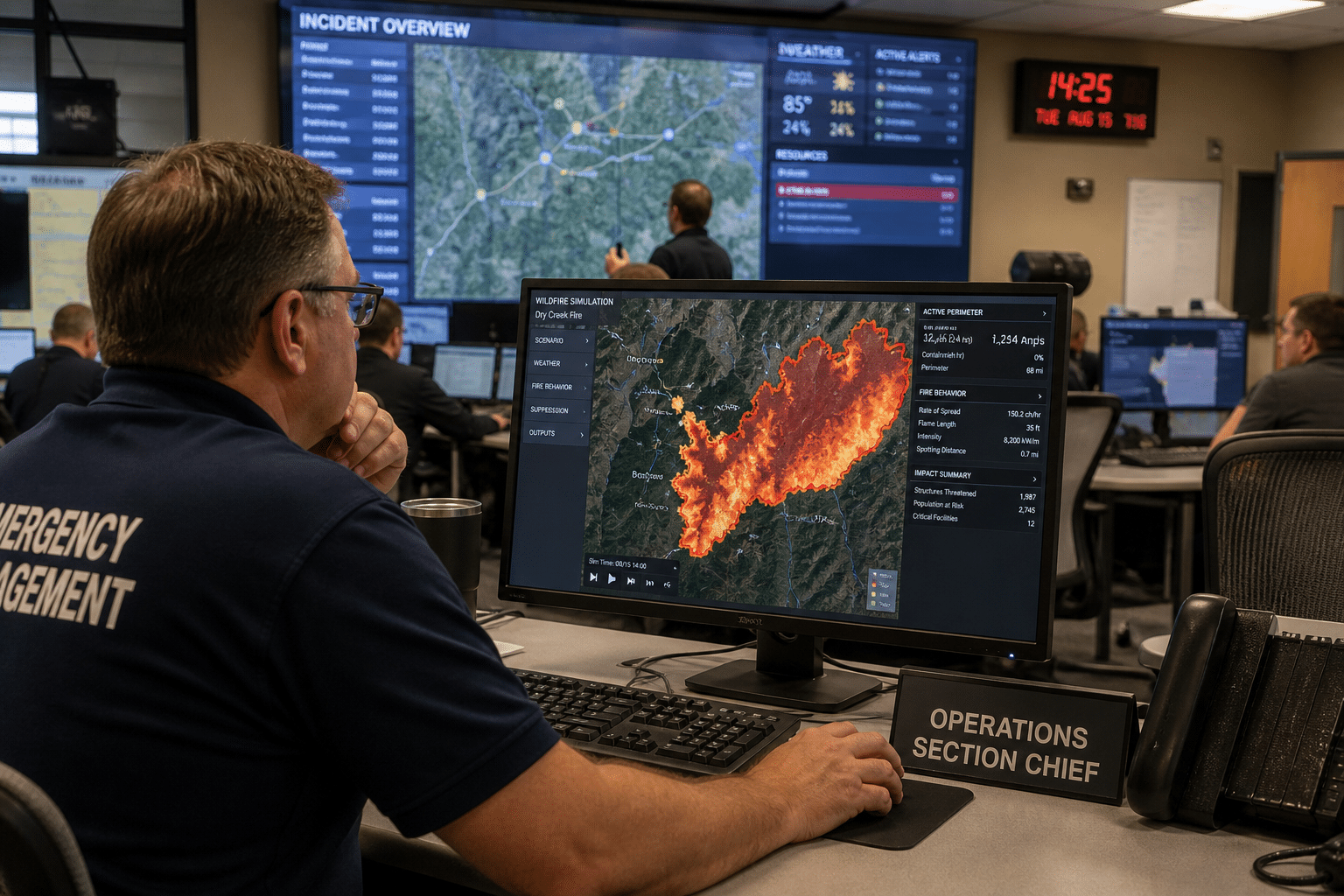
While generative AI often dominates headlines, some of the most promising public safety applications involve simulation and predictive modeling.
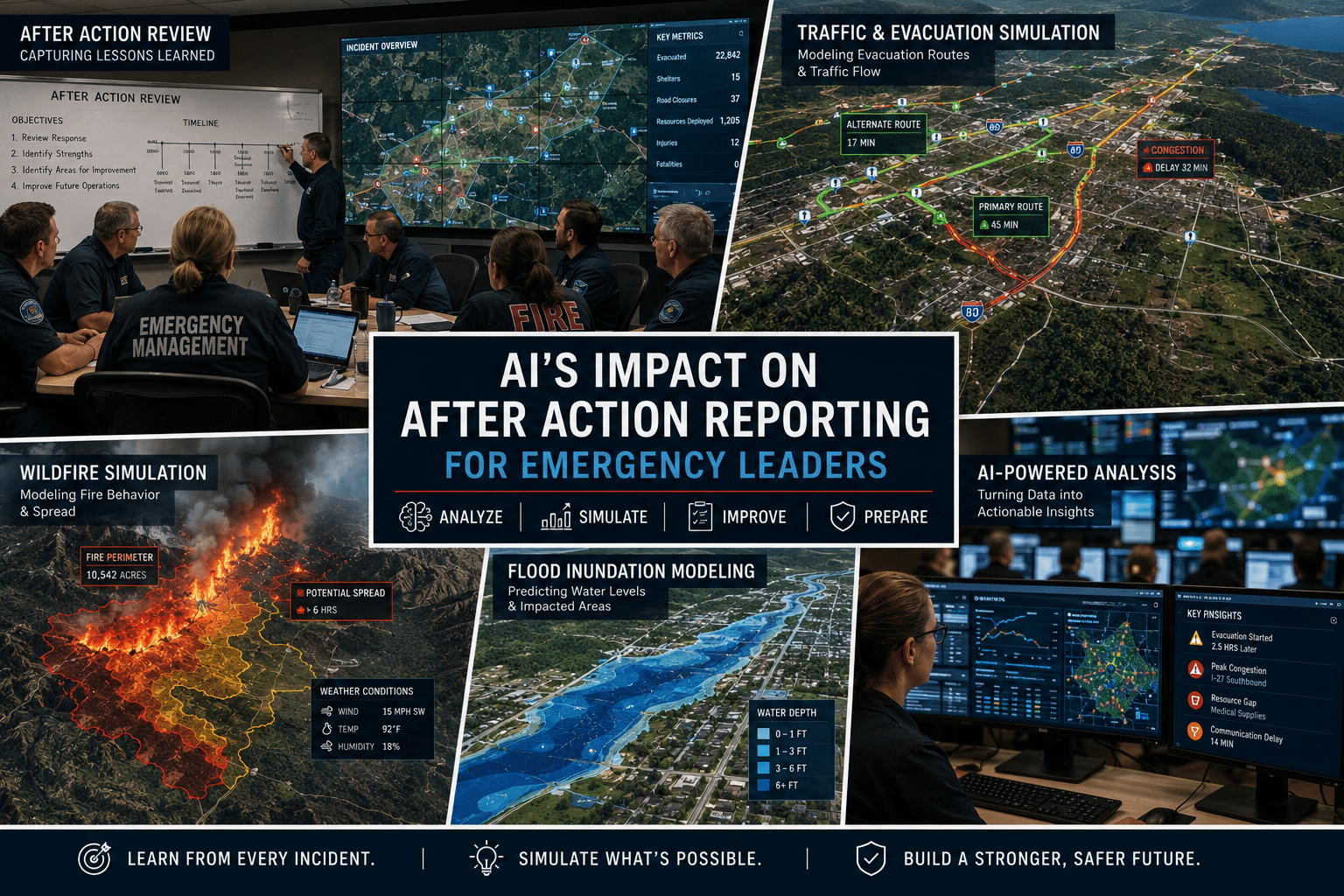
AI-driven simulation technology can help agencies:
- Model evacuation scenarios
- Predict flood impacts
- Analyze traffic flow during incidents
- Identify communication bottlenecks
- Improve resource deployment planning
These tools allow agencies to test assumptions before a disaster occurs instead of learning painful lessons in real time.
Flood modeling technology, including advanced simulation partnerships such as FloodMapp, demonstrates how AI can provide agencies with earlier warning intelligence and more precise operational planning during Severe Weather events.
Likewise, AI-powered intelligence and information gathering platforms such as Peregrine are helping agencies process large amounts of operational data more efficiently while improving investigative and situational awareness capabilities.
In these use cases, AI serves as a force multiplier for trained professionals rather than a replacement for human judgment.
The Future of Public Safety AI Will Depend on Trust
Public safety professionals do not need AI that simply sounds intelligent. They need AI systems that are operationally reliable, transparent, and purpose-built for mission-critical environments.
This is where integrated platforms matter.
Genasys helps agencies strengthen emergency preparedness, evacuation management, operational communications, and situational awareness through technologies designed specifically for public safety environments. Combined with advanced modeling, simulation, and partner intelligence solutions, Genasys supports a more informed and coordinated response strategy across every phase of an incident.
As AI adoption accelerates, agencies that prioritize operational trust, interoperability, and decision support will be better positioned to protect communities while reducing unnecessary risk.
Final Thoughts
AI is already reshaping public safety operations, but not all AI is created equal.
For emergency management and public safety leaders, the goal should not be adopting AI as quickly as possible. The goal should be to adopt AI responsibly.
The agencies that succeed will be the ones that carefully evaluate where AI improves preparedness, strengthens situational awareness, and enhances operational coordination without sacrificing accuracy, transparency, or human oversight.
Contact Genasys to learn how advanced communications, situational awareness, and integrated technologies can help support safer, smarter public safety operations.
FAQs
Why is AI risky in public safety operations?
AI can produce inaccurate or misleading information if it relies on poor data, lacks oversight, or generates 'hallucinations.' In emergency situations, those errors can lead to delayed responses, incorrect evacuations, or public confusion.
How is AI being used in emergency management?
AI is increasingly used for predictive modeling, flood forecasting, evacuation simulation, situational awareness, after action reporting, and intelligence analysis to help agencies improve planning and response.
What types of AI are most useful for public safety agencies?
Purpose-built AI systems focused on simulation, operational intelligence, emergency communications, and geospatial analysis are generally more valuable than generic consumer AI platforms.
Why should public safety agencies be selective about AI vendors?
Public safety environments require secure systems, defensible data, transparency, and operational reliability. Agencies must ensure AI tools meet mission-critical standards before deploying them during emergencies.